

- Trade. Navigate. Prosper. -
The legendary computer game
Ports of Call
now sets sail as a board game.
The computer game
Ports of Call is a classic business simulation game released in 1987 by the German developers Rolf-Dieter Klein and Martin Ulrich.
It quickly became popular on home computers such as the Commodore Amiga, and MS-DOS PCs.
The game puts you in the role of a shipping magnate in the modern global economy of the 1980s. Starting with limited capital, you must purchase ships, take out loans, accept cargo contracts, manage routes between international ports, and compete against rival shipping companies. Your goal is simple but challenging: build the most successful shipping empire.
Explore the original Ports of Call and the legacy that inspired our board game at portsofcall.de.
The board game
Now, 39 years later, we are excited to unveil the upcoming board game for 2-4 players.
In Ports of Call: The Board Game, players compete to build and expand their own shipping empires.
They do so by buying, transporting, and selling containers filled with goods across the globe.
As the game progresses, players can grow their fleets, establish factories in major port cities, and produce goods for the world market.
The winner is the player who, by the end of the game, has built the most valuable shipping company.
All images shown are prototype versions of the game. Components, artwork, colours, and final production quality may be subject to change.

Ships
Ships are the backbone of your empire.
Plan routes carefully, expand your fleet, and stay ahead of your rivals on the open seas.

Orders
Order Cards define market demand and strategic opportunities.
Fulfil contracts at the right time to gain advantages and shape the flow of trade.
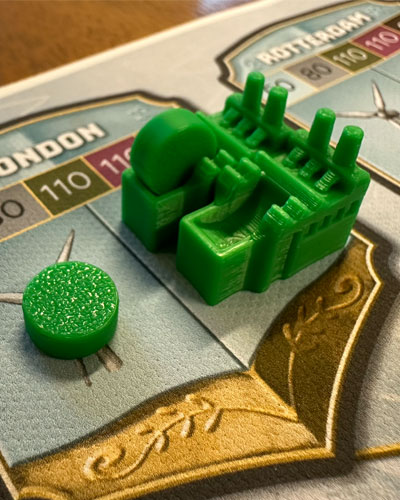
FACTORIES
Factories convert raw materials into valuable goods.
Invest wisely to increase production and secure long-term profits across your trade network.

Fortune
Invest in ships, expand production, and react to changing market conditions.
Managing your wealth wisely is essential to long-term success.
Kickstarter
Now, we are bringing Ports of Call to the tabletop through a dedicated Kickstarter campaign.
Our goal is to transform the spirit and strategic depth of the original computer classic into a modern board game experience. The tabletop edition captures the essence of global trade, financial risk, and competitive expansion — while introducing new mechanics designed specifically for face-to-face play.
Through Kickstarter, we invite both long-time fans and new players to join us on this journey and help bring this ambitious project to life.
Expected launch: 2026
Facebook Community
Be part of the journey behind the Ports of Call board game!
Join our official Facebook group to get:
- Exclusive updates and development news
- Sneak peeks of prototypes and artwork
- Playtesting insights and behind-the-scenes content
- Early announcements about our upcoming Kickstarter
We’re building this game together with the community, and your feedback truly helps shape the final experience.

Game Overview
Players: 2–4
Playing Time: 90–240 minutes
Age: 15+
Genre: Economic Strategy / Trade & Route Management
Languages: German and English
Game Designer: Keld V. Rasmussen
In Ports of Call: The Board Game, players take on the role of ambitious shipping magnates competing to build the most successful trading empire. Over the course of the game, you will purchase ships, fulfil contracts, manage fluctuating markets, and expand your global network of ports and factories. With meaningful decisions every round and dynamic player interaction, the game rewards careful planning, smart investments, and the ability to adapt to changing conditions.

World market
A shared market influenced by every player’s decisions. The more containers available on the market, the lower the purchase price. However, this also means that the selling price decreases, so you earn less when selling your containers.
Players can trade with each other through the world market. When a player produces containers for the world market, they receive payment when another player buys those containers.
To keep track of ownership, each container placed on the world market is marked with the producing player’s token.

Events
Each round in the game features global events that affect trade and movement.
These events draw inspiration from both the computer game and other real-world situations.
Join the journey
Sign up to receive the latest news, updates, and launch details for Ports of Call on Kickstarter.

Ports of Call - The full story
How to be a true Shipping Tycoon
Before logistics simulators and management tycoon games flooded the home computer market, there was one and only Ports of Call — the game that invited you to rule the seven seas from behind a flickering monitor.
The premise was simple, at least on paper: start a shipping company, buy a rusty vessel, chase the most profitable freight contracts, and try not to go bankrupt. But Ports of Call was never just about numbers. It was about risk. Weather. Timing. And occasionally steering your own ship through icy waters while your friends shouted advice from the couch.
Because that was part of its magic: you didn’t just manage ships — you sailed them. When docking in tight harbors, dodging icebergs, or attempting to rescue desperate survivors at sea, the game shifted from spreadsheets to sweaty palms.
And if you failed? Well… let’s just say many players struggled with those rescue missions.
Four Friends, One Computer, Endless Rivalry
Two features helped Ports of Call achieve cult status.
First, up to four players could compete on the same computer. Long evenings turned into epic business wars, as friends tried to outmaneuver each other in freight contracts and fleet expansions. It was true capitalism — in a cozy way.
Second, the visuals.
When the game debuted in 1987, its pixel art was breathtaking. The shimmering water, the dramatic harbor scenes — it all felt alive. Much of that was thanks to American artist Jim Sachs, a master of the craft whose work elevated the entire presentation.
Two Germans, One TV Studio, and a Big Idea
The story of Ports of Call begins not in a harbor, but in a television studio.
The creators, Rolf-Dieter Klein and Martin Ulrich, met through the German television station NDR.
Klein had been fascinated by computers since childhood. As an 11-year-old in the late 1960s, he explored a computer system at his father’s company. A few years later, he built his own primitive “computer game” using LED lights and switches. By the 1980s, his passion had become serious business.
After writing a book about building your own computer, Klein partnered with NDR to create a 26-part educational TV series. Viewers could follow along at home, assembling what became known as the NDR-Klein-Computer. The director of the series? Martin Ulrich.
By day, they taught Germany how to build computers. By night, they played games on the Commodore 64.
One evening, an idea surfaced: why not create a trading game of their own?
Betting on the Future
In 1985, the Amiga 1000 launched, delivering one of the biggest technological leaps of its time. Compared to 8-bit machines, its graphics capabilities felt revolutionary.
Klein and Ulrich saw an opportunity.
Development began in 1986. There was no internet to consult, no forums to browse. They experimented, tested, and experimented again. Fortunately, Commodore’s documentation was solid — and their ambition was stronger still.
They wanted realism. Not just surface-level realism — but deep simulation.
Klein and Ulrich built a weather simulator that mirrored real maritime behavior. They created editing tools for ports and digitized map contours. Ulrich even traveled to London to research authentic shipping terminology. There was no Google. If you wanted information, you packed a bag.
Testing the economic systems alone took weeks. Many weeks.
The Arrival of Jim Sachs
While searching for a publisher, the duo contacted the American company Aegis Development, an early supporter of the Amiga platform.
The gameplay impressed them. The graphics did not.
Fortunately, Jim Sachs was already working with Aegis. The digital artist had made a name for himself with the game Saucer Attack, and later led the graphics team on the Amiga’s top-rated title, Defender of the Crown.
Jim Sachs agreed to overhaul Ports of Call’s visuals.
The result? Stunning water effects. The sea shimmered. Harbors breathed. The world felt alive without complex animation.
Storm Clouds Over the Publisher
Creatively, the collaboration was a success.
Financially, it was not.
Aegis ran into serious financial trouble. Klein and Ulrich never received payment from the game’s sales. They began legal proceedings — but before anything came of it, Aegis Development went bankrupt.
Fortunately, the developers had inserted a clause into their contracts: if the game stopped generating revenue, the rights would revert to them.
That foresight saved Ports of Call.
They reclaimed the rights, re-released the game themselves, and ported it to PC. It found a new audience and continued to generate income — though not enough to sustain them as full-time developers.
The game became popular in both Europe and the United States, where it achieved significant recognition.
The Sequel That Never Sailed
There might have been more.
After Ports of Call, Martin Ulrich traveled to the United States to research a similar game focused on the trucking industry. Plans were also discussed for an aviation-themed title. Like their maritime creation, these games would have blended business simulation with hands-on action sequences.
But Aegis’ collapse ended those ambitions before they could take shape.
While those sequels never materialized, Ports of Call refused to sink.
Klein has continued refining the concept for decades. The series lives on in multiple versions. He works on it in his spare time — navigating a vastly more crowded gaming market than the one he entered in 1987.
It remains a niche product. A quiet classic. A game about cargo ships that somehow became something more.
Because Ports of Call was never just about freight contracts.
It was about ambition. About risk. About steering carefully through rough waters — and sometimes, just sometimes, pulling off a perfect rescue at sea.
Still at Sea — Now as a Board Game
In early 2025, Martin Ulrich and Rolf-Dieter Klein were working on ideas for a Ports of Call board game. However, the project was suddenly put on tragic hold when Martin Ulrich sadly passed away on March 31, aged 76.
After the death of his friend and business partner, Rolf-Dieter Klein decided not to continue the board game project, which for a short period of time seemed lost at sea.
Around the same time, a man named Keld V. Rasmussen presented a board game to the Danish game publishing company Game Inventors. Rasmussen had been working on the game for several years and now felt ready to show it to a publisher. The game’s Danish title was Rederiet (“The Shipping Company”), and it was in many ways inspired by Ports of Call.
Game Inventors was not actively looking for a business simulation game. However, when the company’s CEO, Morten Skovhus, read the email from Keld and saw that the game was inspired by Ports of Call, he became immediately interested. Skovhus himself had been a great fan of the original computer game and, for that reason, felt he simply had to see and try Rasmussen’s board game.
The two fans of Ports of Call played the game, and Skovhus shared a childhood dream — to create the official Ports of Call board game. However, he had never been able to get in touch with the original developers, and so the idea remained just that: a dream never fulfilled.
“Get the approval of the original developers of Ports of Call, and then I am ready to publish the game,” Skovhus told Rasmussen.
Sometimes dreams come true. In this case, they did.
Keld V. Rasmussen managed to contact Rolf-Dieter Klein and present the game to him. Klein found the concept so interesting that a deal was made with Game Inventors as the publisher of the official Ports of Call board game.
After months of additional development and gameplay adjustments involving several members of the Game Inventors staff, the board game was finally ready at the beginning of 2026 — 40 years after the original computer game first came to life.
A new destination is now set for Ports of Call – The Board Game, which will be presented on Kickstarter in 2026.
Game Inventors ApS
Ryttermarken 4A
DK-5700 Svendborg
Denmark